In short
An unsafe building is demolished on the instructions of a técnico competente, who assesses the risk and defines what has to be made safe or taken down. Demoliciones Málaga carries out that work across the province of Málaga, keeps people and neighbouring property out of the danger zone and sends the owner photos in English. Any letter from the ayuntamiento should go to your técnico straight away.
Contents
- What makes a building unsafe enough to demolish?
- You have received a demolition notice or order from the town hall – what now?
- Making safe or demolishing: what are the options for a dangerous building?
- How is a building at risk of collapse demolished?
- Inherited and empty houses: unsafe buildings owned from abroad
- After the emergency: rubble, the cleared plot and your obligations
- Frequently asked questions
What makes a building unsafe enough to demolish?
A building becomes a demolition case when its structure can no longer be trusted to stand, or when repairing it is not technically or economically reasonable. On the Costa del Sol and in inland Málaga we see the same warning signs again and again, typically in houses that have stood empty for years or been inherited by owners who live abroad:
- roofs that have partly fallen in, with rotten timber beams or rusted joists;
- walls with open diagonal cracks, bulging or leaning outwards over a street or a neighbour's plot;
- old adobe, rammed-earth or rubble-stone walls that have been washed out by rain once the roof failed;
- floors and balconies that sag, with exposed and corroded reinforcement;
- damage after heavy storms, a fire or a landslip on a sloping plot.
None of these signs alone decides the outcome. Whether the building is shored up, partly taken down or demolished completely is a technical judgement made by a técnico competente after an inspection. What we bring is the practical side: how the building can be taken down without anyone going under an unstable roof, and how long the work realistically takes.
You have received a demolition notice or order from the town hall – what now?
Get the letter to a técnico or a lawyer as soon as it arrives. A notice from the ayuntamiento about an unsafe building normally sets out what is required and within what period, and the response has to come from you as the owner, usually through your técnico. Ignoring it, or waiting until your next trip to Spain, is the most expensive option.
For owners abroad the practical sequence is usually this:
- Have the letter translated and read by your técnico, who will tell you whether it asks for safety measures, a technical report, repairs or demolition.
- Ask the técnico to inspect the building and define the works in writing.
- Send us that document, photos and the address; we tell you how we would carry it out and send a written quote.
- Once the paperwork your técnico prepares is in place, we agree dates and start.
Demolition orders following a court case or an illegal construction are a different situation: there the legal side is entirely for your lawyer. We only become involved once there is a clear instruction about what is to be demolished. Our guide on ruin declarations and enforcement orders in Spain explains the terms you are likely to find in such letters.
Making safe or demolishing: what are the options for a dangerous building?
Not every dangerous building has to disappear. Depending on the técnico's assessment, there are three broad responses, and they are often combined:
| Response | What it involves | When it is used |
|---|---|---|
| Making safe | Removing loose tiles, cornices, chimneys or a fallen roof section; fencing off the area | The structure is sound but parts may fall onto a street or a neighbour |
| Partial demolition | Taking down the unstable wing, floor or wall and protecting what stays | One part has failed and the rest is worth keeping |
| Total demolition | Controlled demolition of the whole building and clearing of the plot | Repair is not reasonable or the structure as a whole is compromised |
If only part of the house is affected, read our page on partial demolition; if the plot is to be cleared completely, the demolition and debris removal service covers the whole chain down to the delivery receipts.
How is a building at risk of collapse demolished?
A ruined building is demolished from the outside wherever possible, with nobody working underneath or inside an unstable structure. That single principle shapes the method.

- Exclusion zone first. The area around the building is fenced and marked before any work starts; if the danger zone reaches the pavement or the road, the occupation of the public road needs municipal authorisation.
- Machine at a distance. Where access allows, an excavator with a grapple or shears works from outside the collapse radius, pulling the structure inwards and away from neighbours.
- Top-down sequence. Roof, then upper walls, then lower walls – never undermining the base of a wall that is still standing.
- Hand work only where safe. Next to a party wall or a building that stays, the final metres are taken down by hand once the técnico confirms the remaining structure is stable.
- Dust control. Water is sprayed on the rubble to keep dust down, which matters in a narrow street or near neighbouring windows.
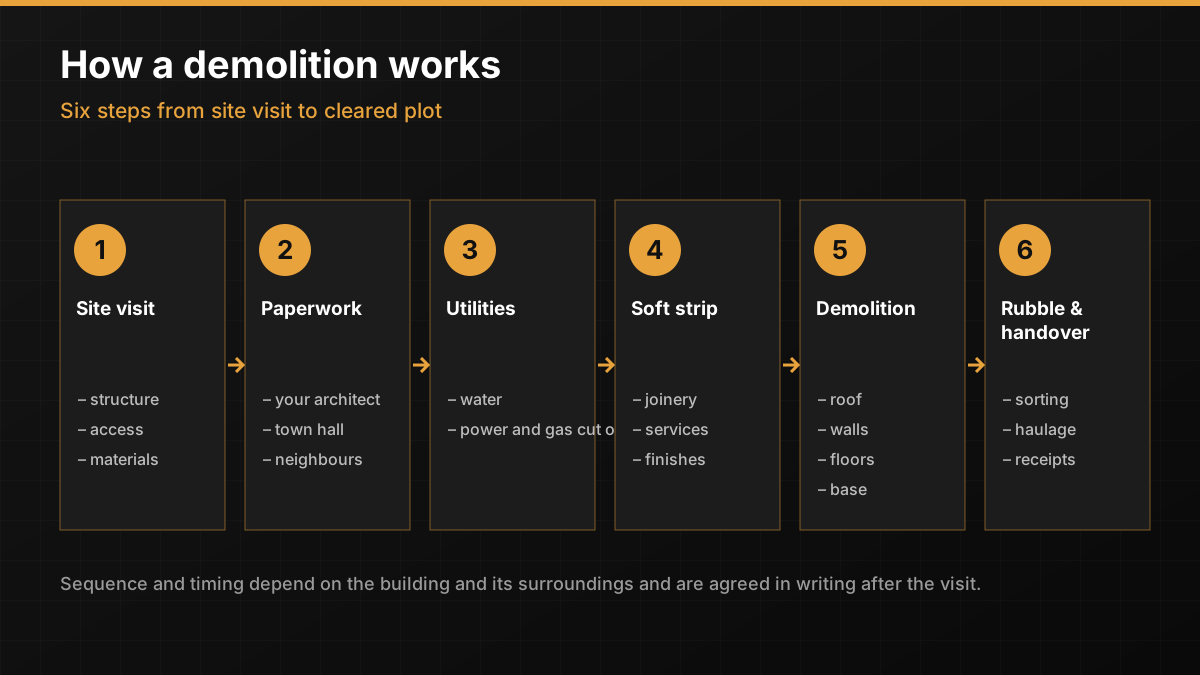
The general sequence of a demolition, from preparation to cleared plot, is shown in our guide demolition step by step.
Inherited and empty houses: unsafe buildings owned from abroad
A large share of the ruined buildings in the province belong to people who do not live nearby – heirs of a village house, owners of a cortijo bought decades ago, families who left a coastal villa empty after a parent died. The structure deteriorates slowly, then quickly once the roof goes, and the first sign the owner receives is often a call from a neighbour or a letter from the town hall.
In these cases we suggest a few things that save time later:
- make sure your técnico and we know who has authority to decide when the property has several heirs;
- arrange for a neighbour, agent or property manager to hold a key and give access for the inspection;
- gather what you have about the property – the deeds, the cadastral reference, old plans or photos;
- check whether the roofs, water tank or outbuildings are asbestos-cement, because that removal goes first and is carried out by a RERA-registered company working as our subcontractor (see uralita removal in Málaga).
We send photos of the building before, during and after the work, so you have a record for the family, the town hall and your técnico. Many of these lessons are collected in what owners wish they had known before demolishing in Spain.
After the emergency: rubble, the cleared plot and your obligations
Once the dangerous structure is down, the waste is sorted and taken to an authorised facility like on any other demolition, and you receive the delivery receipts. Unstable masonry cannot simply be left piled on the plot: it attracts dumping, vegetation and complaints, and it is the next thing the town hall will ask about.
Owners in Andalusia must keep their plots (solares) clean and safe. If they do not, the town hall can order the clearing and carry it out at the owner's expense, as the ordinances of Málaga and Mijas provide. On land within 400 metres of forest areas the plot is also in the Zona de Influencia Forestal, with fire-prevention duties under Ley 5/1999. After the demolition we leave the plot cleared of rubble; for pure vegetation clearing afterwards, ask us – our sister site for plot clearance on the Costa del Sol explains what is involved.
If you are now deciding whether to rebuild, our page on house and villa demolition describes how a demolition is lined up with a new build.
Frequently asked questions
What is imminent ruin?
It describes a building whose structure is so damaged that it may collapse at any moment. Whether a building is in that state is assessed by a técnico competente and, where relevant, the town hall.
Can you demolish a dangerous building straight away?
We can plan the work as soon as a técnico has assessed the building and defined what has to be done. Tell us it is urgent and we will be honest about when we can start.
Who decides whether an unsafe building is demolished or repaired?
The técnico competente who inspects it, in line with what the town hall requires. We carry out the making-safe or demolition they define.
I received a letter from the town hall about my building. What should I do?
Have it translated and read by your técnico or lawyer straight away, then send us a copy with photos. The reply to the town hall comes from you, usually through your técnico.
Do you handle demolition orders for illegal buildings?
The legal side of such an order is for your lawyer. Once there is a clear instruction about what must be demolished, we can carry out the physical work and the waste removal.
Is an emergency demolition done by machine or by hand?
Usually by machine from outside the collapse zone, so nobody works under an unstable structure. Hand work is kept to the parts next to buildings that stay, once they are confirmed stable.
What if the ruined building touches my neighbour's house?
The party wall is recorded before the start, the building is pulled away from it and the final section is taken down by hand. Your técnico decides whether the neighbouring wall needs support.
Can I deal with a ruined house in Spain without travelling?
Yes. With a técnico, someone who can give access and our photo updates in English, the whole process can be managed from abroad.
Does the rubble from a collapsed building need special handling?
It is sorted like any demolition waste. Asbestos-cement is the exception: it is removed separately by a RERA-registered subcontractor and never mixed with the rest.
Can the town hall clear my plot and charge me?
Owners must keep solares clean and safe; if they do not, the town hall can order the clearing and carry it out at the owner's expense, as the ordinances of Málaga and Mijas provide.