Emergency demolition of unsafe and ruined buildings
Buildings in ruin, partial collapses and town hall notices: made safe and demolished on your técnico's instructions.
Costa del Sol · province of Málaga
We demolish houses, villas, fincas and whole buildings anywhere in the province of Málaga – by hand, by machine or both – and take the rubble away, while you follow the job in English from wherever you live.

In short
Demoliciones Málaga is a demolition contractor based in Marbella that works across the whole province of Málaga. It carries out total and partial demolitions and debris removal using your architect's documentation, and keeps owners abroad informed in English with photos at each stage. The permit itself – declaración responsable or licence – is filed by the owner and their técnico, not by the contractor.
Seven ways owners usually come to us – from a single outbuilding to a whole villa that is making way for a new house. Pick the one closest to your situation; each page explains the work, the paperwork around it and what you need to send us.
Buildings in ruin, partial collapses and town hall notices: made safe and demolished on your técnico's instructions.
Multi-storey blocks, old commercial and mixed-use buildings taken down top-down, with selective strip-out and waste sorting.
Knock down, sort, load and take away: complete demolition with waste removal and site clearance, plus delivery receipts.
Extensions, wings, upper floors, porches and roofs removed while the rest of the house stays standing and protected.
Cortijos, farmhouses, stores, stables and ruins on rural plots, with access tracks and waste transport planned first.
Demolish and rebuild: old houses and villas taken down selectively and the plot handed over ready for the new build.
For owners who live abroad: English communication, written scope, photo updates and coordination with your architect.
A demolition service takes a structure down safely, separates what comes out of it and leaves the plot or the remaining building ready for the next step. In practice that means three kinds of work, often on the same job: manual demolition where machines cannot reach or where part of the building has to survive, mechanical demolition with excavators and attachments for whole structures, and a combined approach that strips by hand first and brings the machine in afterwards.
For owners on the Costa del Sol and inland Málaga, the jobs we are asked about most fall into seven groups:
What a demolition contractor does not do matters just as much. We do not draft the demolition project, we do not sign technical certificates and we do not obtain licences. Those belong to your architect or another técnico competente, and to you as the owner. Our part is the physical work, carried out on the basis of that documentation.
Yes, a demolition always needs a municipal permit, but in Andalusia it is usually not a full licence any more. Since Decreto-ley 3/2024 of 6 February, the total or partial demolition of a building is carried out by declaración responsable – a sworn statement filed with the ayuntamiento – provided the building is not under heritage protection and does not stand in a protected setting. A licencia urbanística is still required for protected buildings, for buildings in a protected setting (entorno) and for archaeological zones.
The rules come from the Andalusian planning law, Ley 7/2021 (known as LISTA), and its general regulation, Decreto 550/2022. Before 2024 the general rule for demolitions was the licence, which is why many older forum threads and agents' advice still talk about waiting for a "demolition licence". Overseas owners also search for "licencia de obras", "major works permit" or "minor works permit": those are general terms for building works, and the right route for your demolition is something your técnico confirms with the town hall.
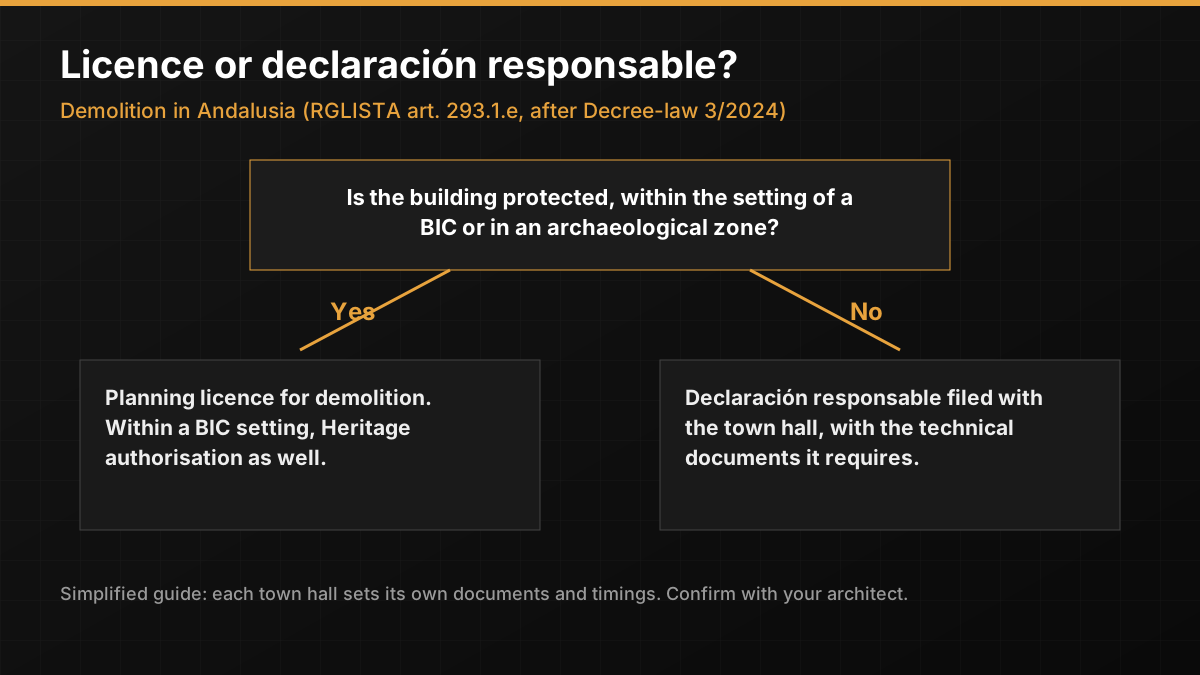
Two practical consequences follow. First, each ayuntamiento decides which documents go with the declaración responsable in its own ordinance, so Marbella, Estepona, Mijas or Nerja can ask for different paperwork; check with your técnico or the town hall. Second, in Málaga city the new municipal licensing ordinance (OMLU, in force since the end of December 2025) asks, among other things, for a project or technical report signed by a técnico competente plus a technical certificate, and photographs. The details are in our guide to demolition permits in Andalusia and the specific one on what the GMU asks for in Málaga city.
Every demolition in Spain has three sets of responsibilities, and confusion between them is the most common reason a job stalls. The owner (the promotor) decides and pays, the técnico prepares and signs the documentation, and the contractor executes.
| Role | Typical tasks |
|---|---|
| Owner (promotor) | Commissions the técnico, files the declaración responsable or licence application with the ayuntamiento, identifies themselves with their DNI, NIE or NIF for the municipal and tax formalities, appoints a health and safety coordinator when several companies work on site. |
| Técnico competente | Drafts and signs the project or technical report, the health and safety study and the waste management study; directs the work where the job requires it. |
| Demolition contractor | Prepares its own health and safety plan and waste management plan, demolishes, sorts and removes the waste, hands over delivery receipts. |
Under Real Decreto 1627/1997 each demolition has either a health and safety study or a basic study, depending on the size of the job; the contractor writes its health and safety plan from it. Our guide on who signs a demolition project explains when a full project is needed, and the one on health and safety on a Spanish demolition site covers the study, the plan and the coordinator.
Demolishing an old house to build a new one is often the cleaner route when the structure, the layout and the installations all fall short of what you want. Many villas built along the coast in the 1960s, 70s and 80s have shallow foundations, poor insulation, flat roofs that leak and extensions added over the decades; renovating them can mean paying to keep problems.
A knock-down-and-rebuild project normally follows this order: your architect designs the new house and checks what the planning rules allow on the plot; the demolition is prepared and filed with the ayuntamiento; we demolish, sort the waste and clear the plot down to the level your architect specifies; then the builder of the new house takes over. Coordinating the end of the demolition with the start of the new build saves weeks of an empty, fenced plot.
Whether rebuilding beats renovating depends on the building, the plot and what the planning rules let you build again. We cover that trade-off from several angles in is it worth knocking down and rebuilding instead of renovating? and renovate or rebuild: deciding on an old villa or finca. The technical side of the demolition itself is on our house and villa demolition page.
Yes. Most of the owners we work with on the Costa del Sol live in the UK, Scandinavia, the Netherlands, Germany or elsewhere for most of the year, and the demolition can run without them on site. What makes it work is a clear written scope before the start, a single contact who answers in English, and regular photo updates so that you can see the progress instead of imagining it.
Read how this works day to day on managing demolition from abroad and in what it is actually like to work with us while you are abroad. If you are still weighing up the risks, common worries of foreign owners before a demolition answers the questions we hear most.
Demolition waste in Spain may not leave the site as one mixed heap. Ley 7/2022 on waste and contaminated soils requires that, since July 2022, non-hazardous construction and demolition waste is sorted at least into wood, mineral fractions (concrete, bricks, tiles, ceramics, stone), metals, glass, plastic and plaster, with reusable elements set aside. Since January 2024 selective demolition is mandatory: the building is taken apart in an order that keeps those fractions clean.

On our jobs the sorting happens on site as the building comes down – roof tiles, timber, metal and masonry go to separate piles or containers – and the waste goes to an authorised facility. You receive the delivery receipts (justificantes de entrega). They are your proof of correct disposal; the town hall may require a deposit or guarantee for construction waste that is returned once delivery to an authorised manager is proven, and the amount depends on the municipal ordinance.
Hazardous materials are a separate stream. Asbestos-cement (the "uralita" of old roofs, water tanks and pipes) is never mixed with other waste, and its removal is carried out by a RERA-registered company working as our subcontractor – our sister site Retirada de Uralita Málaga explains that process. The full picture of selective demolition is in our guide selective demolition is now mandatory in Spain, and the waste side, including the European waste codes, on construction and demolition waste rules in Spain. Our demolition and debris removal service covers the whole chain.
Demoliciones Málaga handles the main structure – the house, the building, the finca. Some parts of a project have their own technique and their own questions, so the network has specialist sites for them, all run by the same business:
On a typical villa rebuild these usually happen in one sequence – interior strip-out where something is salvaged, asbestos removal by the RERA-registered subcontractor if there is any, then the main demolition, then the pool – so you deal with one contact and one schedule.
There is no honest single figure for demolishing a house, because the cost depends on a handful of factors that change from plot to plot. We do not publish prices on this site; instead, every quote is written for the specific building after we have seen photos or the site.

For a first orientation, our sister site has a demolition cost calculator that gives a rounded band, and what drives the cost of knocking down a villa on the Costa del Sol goes through each factor with examples. The IVA rate applicable to the work is stated in each quote.
We work in every comarca of the province of Málaga, from the Costa del Sol Occidental – Marbella, Estepona, Mijas, Fuengirola, Benalmádena, Torremolinos, Manilva, Casares – to Málaga city, the Axarquía (Nerja, Torrox, Vélez-Málaga, Rincón de la Victoria), the Guadalhorce valley, Antequera and the Serranía de Ronda. The office is in Marbella.
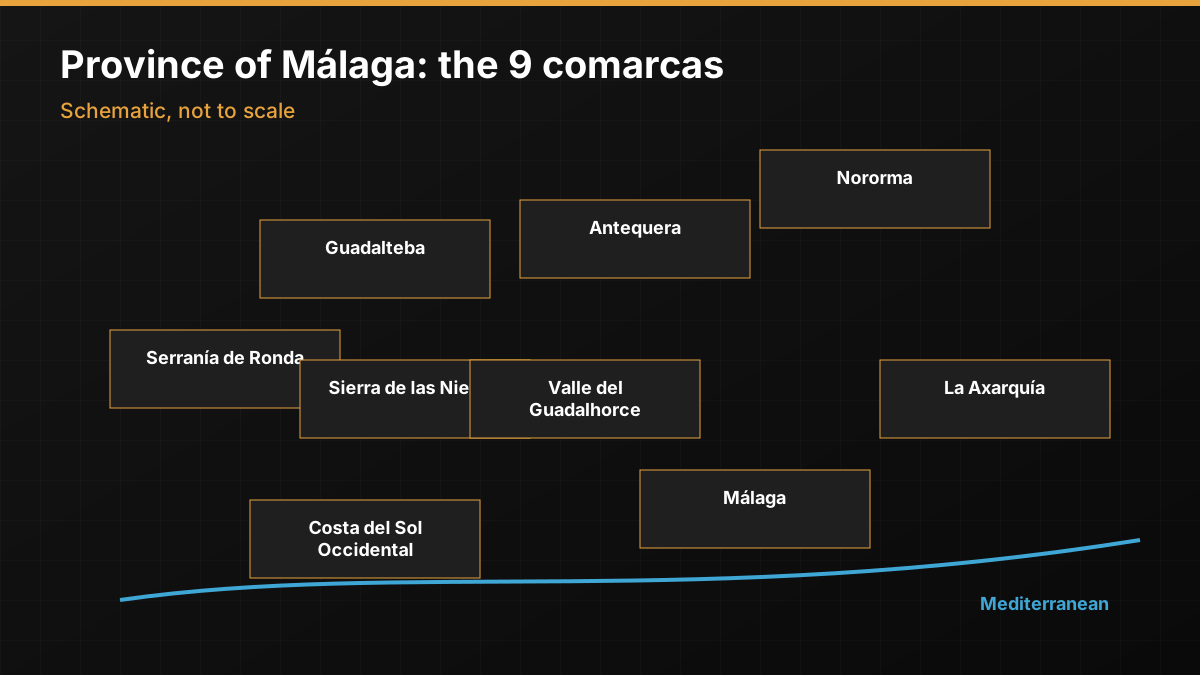
The setting changes the job more than the distance. A villa in an urbanización with a wide road and a flat plot is a very different demolition from a terraced house in a white village with stepped lanes, or a cortijo at the end of an unpaved track. Historic centres add the heritage regime; dense coastal streets add the occupation of the public road by skips and machines, which needs its own municipal authorisation. Our guide to demolition rules in Marbella, Estepona, Mijas and other Costa del Sol towns sums up what is known per town, and the areas we cover page has a section for each municipality.
If you want the full sequence of a job before contacting anyone, demolition step by step: from site visit to cleared plot walks through it, and ruin declarations and enforcement orders covers the situation where the town hall has already been in touch.
You send photos, the address or municipality, approximate size and what must stay standing – in English, by e-mail or WhatsApp.
We look at the building, access and waste on site or, if you are abroad, with whoever has the keys, and send a written, itemised quote.
Your architect or técnico prepares the documentation and you file the declaración responsable or licence; we supply what they need from us.
We agree dates with you and your architect, check that supplies are disconnected and set up the site, fencing and containers.
The building comes down in order, waste is sorted on site, and you get photos at each stage.
The plot is left clean to the agreed level, and you receive final photos and the waste delivery receipts.

The same house in three photos: standing with its skip, partly demolished with brick and timber sorted, and the cleared plot.
Aerial view of a Liebherr excavator taking down an old villa with buildings close on every side.

Hitachi excavator with a crusher working on a multi-storey concrete structure, with water spray against dust.
Licence or declaración responsable? How the 2024 change works for demolitions in Andalusia and when heritage rules still require a licence.
The OMLU ordinance explained: which route a demolition takes in Málaga city, which documents the GMU expects and what changes in the Centro Histórico.
Proyecto or memoria técnica, safety and waste studies, contractor plans: who drafts and signs each demolition document, and when.
Structure, access, pools, uralita, waste sorting and paperwork: the real price factors behind a villa demolition on the Costa del Sol.
When rebuilding beats renovating an old house in Málaga province – and the cost questions owners abroad should settle first.
Paperwork, rubble, asbestos, neighbours and distance: the worries owners abroad raise before a Spanish demolition, with straight answers.
Our specialist sites
Yes. We take on demolitions across the whole province of Málaga, coastal and inland, from Manilva and Casares to Nerja, Antequera and Ronda. The office is in Marbella.
Yes. You can contact us in English or Spanish by e-mail, phone or WhatsApp, and quotes and updates can be in English.
No. Many owners follow the whole job from abroad through photo updates and written messages, with their architect and whoever holds the keys handling anything on site.
Since Decreto-ley 3/2024 most total or partial demolitions are carried out by declaración responsable filed with the ayuntamiento. A licence is still needed for protected buildings, protected settings and archaeological zones.
No. The owner and their técnico file the declaración responsable or the licence application. We work with that documentation and supply whatever information about the works they ask us for.
The documentation of a demolition – project or technical report, health and safety study and waste management study – is drafted and signed by a técnico competente. Its scope depends on the job and on what each town hall asks for.
It is a sworn statement that the owner files with the town hall, declaring that the works meet the rules and that the required documents are available. Each ayuntamiento sets those documents in its ordinance.
Yes. In a protected historic centre such as Málaga's Centro Histórico, Ronda or Vélez-Málaga, a demolition needs a licence and, where applicable, heritage authorisation. Confirm it with the ayuntamiento first.
It is sorted on site into separate fractions – concrete and masonry, wood, metal and others – and taken to an authorised facility. You receive the delivery receipts.
Asbestos-cement is removed before the demolition by a RERA-registered company working as our subcontractor, under its own approved work plan. We coordinate the rest of the demolition around it.
Yes. Partial demolition of a wing, an extension, an upper floor or a roof is common; the part that stays is protected and the work near it is done by hand.
Yes, as part of the same project. Our sister site for pool demolition on the Costa del Sol explains demolition versus infill and compaction.
It depends on the structure, size, access, waste and how much hand work is needed. We do not publish prices; you get a written quote, and our price sister site has a calculator for a first rounded band.
The written quote describes the scope, the technique and what is included, such as waste removal and the level the plot is left at. Anything outside that scope is agreed in writing before it is done.
For the municipal and tax formalities of the works, the owner identifies themselves with their DNI, NIE or NIF. Your técnico or gestor will tell you which one applies in your case.
Party walls, shared drives and neighbouring roofs are recorded before the start and protected during the work. If the house is part of a community of owners, the community has to be informed beforehand.
The owner arranges the disconnection with the supply companies, often through their architect or property manager. We check that supplies are cut before starting.
We leave it cleared of demolition waste and, where agreed, with a basic levelling after the demolition, to the level your architect specifies for the new build.
Yes. Rural buildings on rustic land are demolished with the same procedure; access tracks and distance to the waste facility are what we look at first.
Send photos, the address or municipality, approximate size, what must stay and your preferred dates to the e-mail or WhatsApp on our contact page.
This form is sent straight to oficina@demolicionesmalaga.eu.
Send us photos, the address and what has to stay standing – in English – and you will get a written, no-obligation quote.