In short
A partial demolition takes down a defined part of a building while the remaining structure stays in use or ready for reconstruction. It needs a técnico's definition of where the cut is and how the retained part is supported. Demoliciones Málaga carries it out across the province of Málaga, combining machine work away from the retained part with hand demolition next to it.
Contents
What is partial demolition?
Partial demolition is the removal of a specific part of a building – structural or not – while the rest of the building is kept. It sits between an interior strip-out, where the shell stays intact, and a total demolition, where nothing stays. On houses and villas in the province of Málaga the most frequent cases are:
- an extension, garage or annex added over the years, often of poorer construction than the original house;
- a wing of a villa that is to be rebuilt with a new layout;
- an upper floor or a roof that is replaced to add height, change the shape or end persistent leaks;
- porches, covered terraces and pergolas built in masonry;
- the damaged part of a building after a partial collapse – see emergency and unsafe buildings.
If what you need is the removal of internal walls, kitchens or bathrooms with the shell untouched, that is interior demolition, covered by our sister site for wall removal in Málaga.
Why the part that stays decides the method
On a partial demolition the hardest work is not what comes down but what stays up. The retained structure has to remain stable during and after the demolition, and that is a technical decision before it is a practical one.
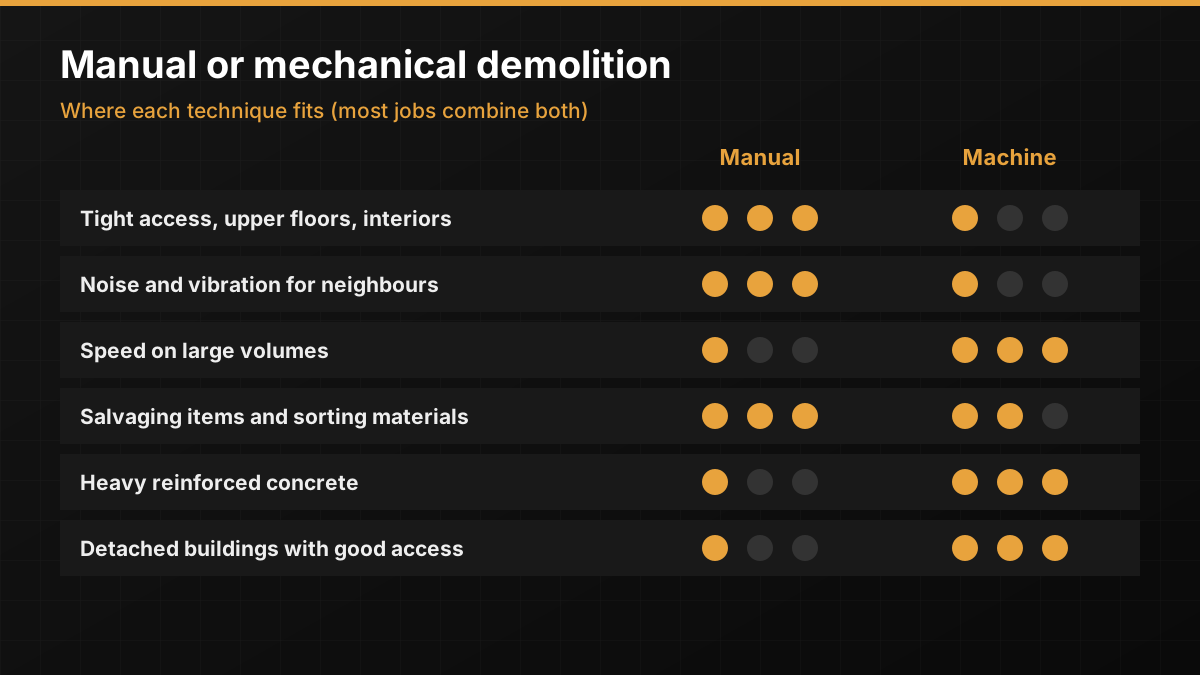
Your técnico defines where the cut line runs, which walls or beams have to be propped or reinforced first, and in which order the elements are removed. With that definition, the work is organised in two zones:
| Zone | Technique | Why |
|---|---|---|
| Away from the retained part | Mechanical: excavator with grapple, shears or breaker | Faster, keeps workers out of reach of falling elements |
| Along the cut line | Manual: demolition hammers, cutting, careful dismantling | No vibration or impact on the structure that stays |
| Roof and upper floors over occupied rooms | Manual, top-down, with protection below | The building underneath remains in use |
The edges left by the demolition – wall ends, exposed slab edges, the line of the old roof – are left clean and, where the técnico requires it, protected from rain until reconstruction begins.
Do I need a permit for a partial demolition?
Yes, a partial demolition needs the same municipal route as a total one. In Andalusia, since Decreto-ley 3/2024, the total or partial demolition of buildings is carried out by declaración responsable, unless the building has heritage protection or lies in a protected setting or archaeological zone, where a licence is still required.
In Málaga city the OMLU ordinance asks, for partial-demolition licences, for a nota simple from the land registry less than three months old, in addition to the general documents. In other municipalities, each ayuntamiento sets out the documents and deadlines in its ordinance; consult your técnico or the town hall. The documentation itself – project or technical report, health and safety study and waste management study – is signed by a técnico competente.
When the partial demolition is the first phase of a reconstruction, the paperwork is often prepared together with the new works; how that is done is for your architect. The differences between full and partial demolition for permits and works are compared in full vs partial demolition: what changes, and the roles are explained in who signs a demolition project in Spain.
Partial demolition in a community of owners
Many partial demolitions on the coast happen in townhouses, semi-detached villas and apartment buildings under propiedad horizontal. There, Ley 49/1960 applies: before demolishing walls, structure or façade elements, the community must be informed, and works affecting common elements need the agreement of the owners' meeting.
In practice, that means talking to the community administrator early, especially if the part you want to remove touches a shared roof, a party wall, a façade or a shared terrace. We coordinate dates and access with the administrator once the agreement is in place, and we document the condition of the common elements with photos before starting. Our page on managing demolition from abroad explains how that coordination works when you are not in Spain.
Partial demolition and reconstruction: lining up the two phases
A partial demolition is almost always followed by building work, so the end of one phase should hand over cleanly to the start of the next. What helps:
- Agree the handover state. Which slab edges, wall ends and reinforcement have to be left exposed for the new structure, and which are cut back.
- Protect the house. Temporary covers on openings and on the line of the old roof if there is a gap before reconstruction.
- Keep what you want to reuse. Old roof tiles, beams, doors or ironwork are set aside during the strip-out.
- Share the programme. We give your architect and builder our dates so that the new works can follow on.

If, during the planning, it turns out that more of the house would have to go than expected, it is worth comparing with a total demolition; renovate or rebuild helps with that decision, and house and villa demolition describes the full option.
Waste from a partial demolition
A partial demolition produces less waste than a total one, but often in a more awkward place – behind the house, on a terrace, at the end of a narrow garden. The rubble is sorted into the same fractions as on any demolition, moved to the loading point by small machine or by hand, and taken to an authorised facility; you receive the delivery receipts.
If the building's roof or any annex is asbestos-cement, that part is removed first by a RERA-registered company working as our subcontractor. The rest of the waste chain is described on demolition and debris removal, and the legal background in selective demolition under Law 7/2022.
Frequently asked questions
What counts as partial demolition?
Any demolition that removes a defined part of a building – an extension, a wing, an upper floor, a roof, a porch – while the rest is kept. Internal walls with the shell untouched are interior demolition.
Is a partial demolition cheaper than a total one?
Not always in proportion. Hand work along the cut line and protection of the retained structure take time, so the cost depends more on the method than on the volume removed.
Does a partial demolition need a licence?
In Andalusia it generally goes by declaración responsable, like a total demolition. Buildings with heritage protection, in a protected setting or in archaeological zones need a licence.
Who decides where the cut is made?
The técnico competente who prepares the documentation. They also decide what needs propping or reinforcing before the work starts.
Can I live in the house during a partial demolition?
Sometimes, if the técnico considers it safe and the part being demolished can be separated. Dust, noise and access restrictions usually make it impractical for the closest rooms.
Do I need the community's agreement to remove an extension?
If the building is under propiedad horizontal and the works affect common elements, yes, the owners' meeting has to agree. In any case the community must be informed before structural or façade elements are demolished.
Can you remove just the roof?
Yes. Roofs are removed top-down, usually by hand over rooms that stay, with temporary protection if the new roof does not follow immediately.
Do you also do the reconstruction?
No. We carry out the demolition and leave the structure ready for the builder of the new works, coordinating dates with your architect.
Are old materials kept for reuse?
Yes, if you ask. Tiles, beams, doors or ironwork are set aside during the strip-out, before the structural demolition.
What about the neighbour's wall?
Party walls are documented before the start and the demolition along them is done by hand. Whether they need any support is decided by your técnico.