In short
House and villa demolition is the complete removal of a detached or semi-detached home, usually to build a new one on the same plot. Demoliciones Málaga carries it out across the province of Málaga with selective strip-out, mechanical demolition and waste sorting, to the documentation of your architect, and hands over a cleared plot with photo updates in English throughout.
Contents
- When does it make sense to demolish a house rather than renovate?
- The home demolition process, step by step
- Manual, mechanical or combined: how is a villa demolished?
- Demolishing in an urbanización: neighbours, access and rules
- What stays, what goes: agreeing the scope before the start
- What do we need from you to quote a house demolition?
- Handing the plot over to your builder
- Frequently asked questions
When does it make sense to demolish a house rather than renovate?
Demolishing a house makes sense when keeping it would cost more – in money, compromises or risk – than starting again. Owners on the Costa del Sol usually reach that point for one or more of these reasons:
- the structure is weak, poorly founded or has been extended so often that it no longer works as a whole;
- the layout, ceiling heights and orientation cannot be fixed without rebuilding most walls anyway;
- installations, insulation and waterproofing all have to be replaced;
- the new design – more glass, a different footprint, a basement – is simply not compatible with the old house.
Whether it pays off depends on what the planning rules let you rebuild on the plot, and that is the first thing your architect should check. Two of our articles look at the question from both sides: is it worth knocking down and rebuilding instead of renovating? and who should (and shouldn't) rebuild instead of renovating.
The home demolition process, step by step
A villa demolition follows a fixed order, because each stage keeps the next one clean and safe. A typical sequence on a detached house:
- Documentation and permit. Your técnico prepares the documents; you file the declaración responsable or licence with the ayuntamiento.
- Preparation. Supplies disconnected, site fenced, items to keep marked and, if needed, authorisation for the public road.
- Hazardous materials. Any asbestos-cement removed first by a RERA-registered company working as our subcontractor.
- Selective strip-out. Doors, windows, timber, metal, plastics, plaster and sanitary ware removed by hand.
- Roof and structure. Roof tiles and timbers, then walls and floors, by machine, with hand work next to boundaries.
- Slabs, foundations, extras. Floor slabs, foundations, terraces and the pool if included.
- Clearing and handover. Last waste removed, plot left at the agreed level, receipts and final photos to you.
The guide demolition step by step: from site visit to cleared plot goes into each stage in more detail.
Manual, mechanical or combined: how is a villa demolished?
Almost every villa demolition is combined: the strip-out and the work next to boundaries are done by hand, the structure by machine. The balance depends on the plot.
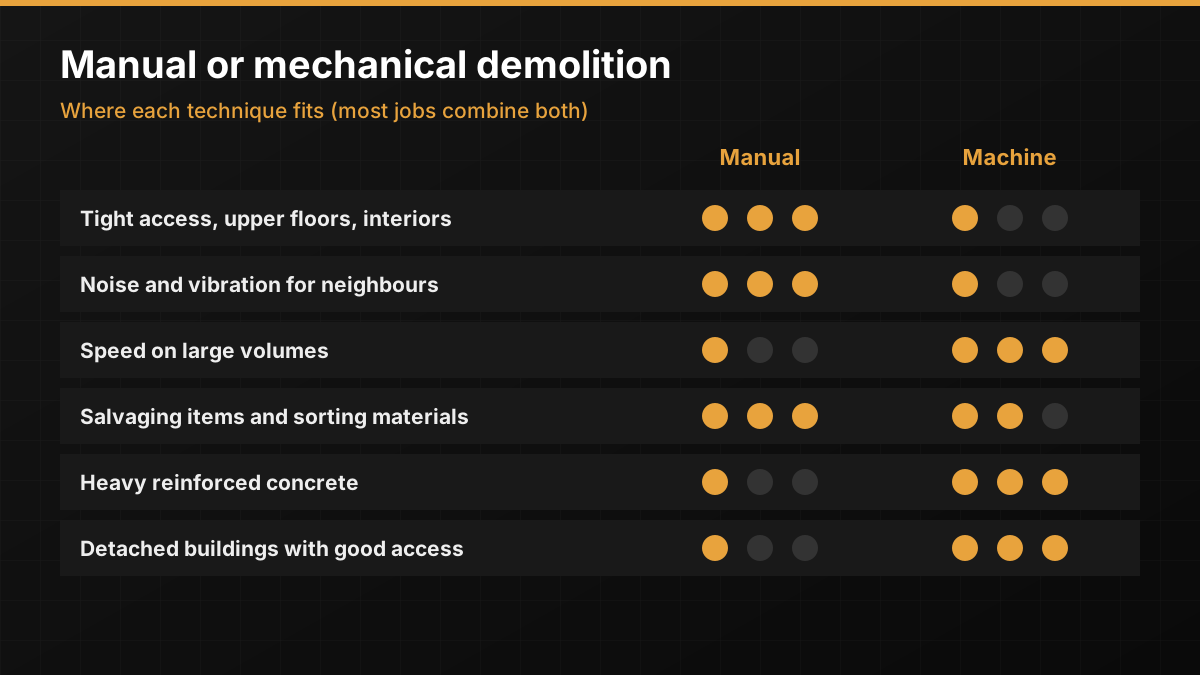
On a detached villa with a good drive, a medium excavator with a grapple or shears does most of the work, which is faster and keeps workers away from falling elements. On a semi-detached or terraced house, or one built right up to a neighbour's wall, more of the work along the shared side is done by hand. In a dense urban setting or a steep pueblo street, machine size is limited by access and the work is planned around the street.

Water is sprayed during the demolition to keep dust down, which matters in an urbanización where neighbours are close and often at home.
Demolishing in an urbanización: neighbours, access and rules
Many villas on the coast are in urbanizaciones with narrow roads, gated entrances and neighbours a few metres away. That is where the planning before the start pays off most.
- Access: whether a lorry and a machine can get through the gate and up the road, and where they can stand.
- Neighbours: walls, roofs and gardens next to yours documented with photos before the start; boundary walls protected or rebuilt if agreed.
- Public road: a skip or machine on the street needs municipal authorisation to occupy the public road.
- Community: where the villa is part of a community of owners under propiedad horizontal, the community must be informed beforehand and works on common elements need the owners' meeting agreement.
- Working hours: the job follows the municipal rules and any internal rules of the urbanización that your administrator tells us about.
Pools in these plots are usually removed in the same job; the technique – demolition or infill – is explained on our sister site for pool demolition.
What stays, what goes: agreeing the scope before the start
Most disagreements at the end of a demolition come from things nobody wrote down at the beginning. Before we start, the written scope lists:
- buildings and structures to be demolished – house, garage, annexes, terraces, pool;
- what stays – boundary walls, gate, trees, a cistern, a retaining wall, the neighbour's party wall;
- whether slabs and foundations are removed or left for the new build;
- the level and condition the plot is left in, as your architect specifies;
- materials you want to keep, such as tiles, ironwork or stone.
That list is what we photograph against at the end, so you can check it from abroad. If you are not in Spain during the job, read managing demolition from abroad.
What do we need from you to quote a house demolition?
A first written quote for demolishing a house can be prepared from good photos and a few figures, and then confirmed on site. Please send:
- photos of every façade, the roof, the garden side and the access from the road, including the gate;
- the municipality and urbanización, or the full address;
- approximate built area, number of floors and whether there is a basement or semi-basement;
- extras on the plot: pool, terraces, garage, annexes, retaining walls;
- anything you suspect is asbestos-cement, such as an old water tank, downpipes or a shed roof;
- your architect's details and, if available, the date the new build should start.
With that, we can describe the method, the waste handling and the handover state in the quote, so you can compare like with like.
Handing the plot over to your builder
The demolition ends when the plot is handed over in the condition the new build needs. Agreeing that handover state with your architect and builder in advance avoids a second machine visit. Sometimes the builder wants the foundations left as a working platform; sometimes everything has to go down to natural ground.
All demolition waste is sorted, removed to an authorised facility and documented with delivery receipts – see demolition and debris removal. For the factors that drive the cost of a villa demolition, read what drives the cost of knocking down a villa on the Costa del Sol, and for a first rounded band use the demolition calculator.
Frequently asked questions
Can I demolish my house and build a new one in Spain?
Usually yes, but what you may rebuild depends on the planning rules for your plot, which your architect checks first. The demolition itself needs a declaración responsable or licence filed with the ayuntamiento.
How long does it take to demolish a villa?
It depends on size, structure, access, hand work and waste volume. You get a realistic programme with the quote, agreed with your architect's timetable.
Do you need to see the house before quoting?
Photos and a description give a first quote; a site visit, or a visit with whoever holds the keys, confirms details such as access and materials.
Is the pool demolished at the same time?
It can be, as part of the same job. Whether it is demolished or filled in depends on what your architect plans for the plot.
Do you remove the foundations?
If the scope includes them. Sometimes the builder prefers to keep them as a working platform; that is agreed before the start.
What if my villa shares a wall with the neighbour?
The shared wall is recorded before the start and the demolition along it is done by hand. Your técnico decides whether it needs support or finishing.
Can I keep anything from the old house?
Yes. Tiles, doors, ironwork, stone or anything else you want are set aside during the selective strip-out.
Will there be a lot of dust?
Water is sprayed during the demolition to keep dust down, and the work is sequenced to keep debris on the plot.
Who files the permit for my house demolition?
You as the owner, with the documentation prepared by your técnico. We supply them any information about the works they need.
Do you also build the new house?
No. We demolish, clear and hand over the plot to the builder you choose, coordinating dates with your architect.