In short
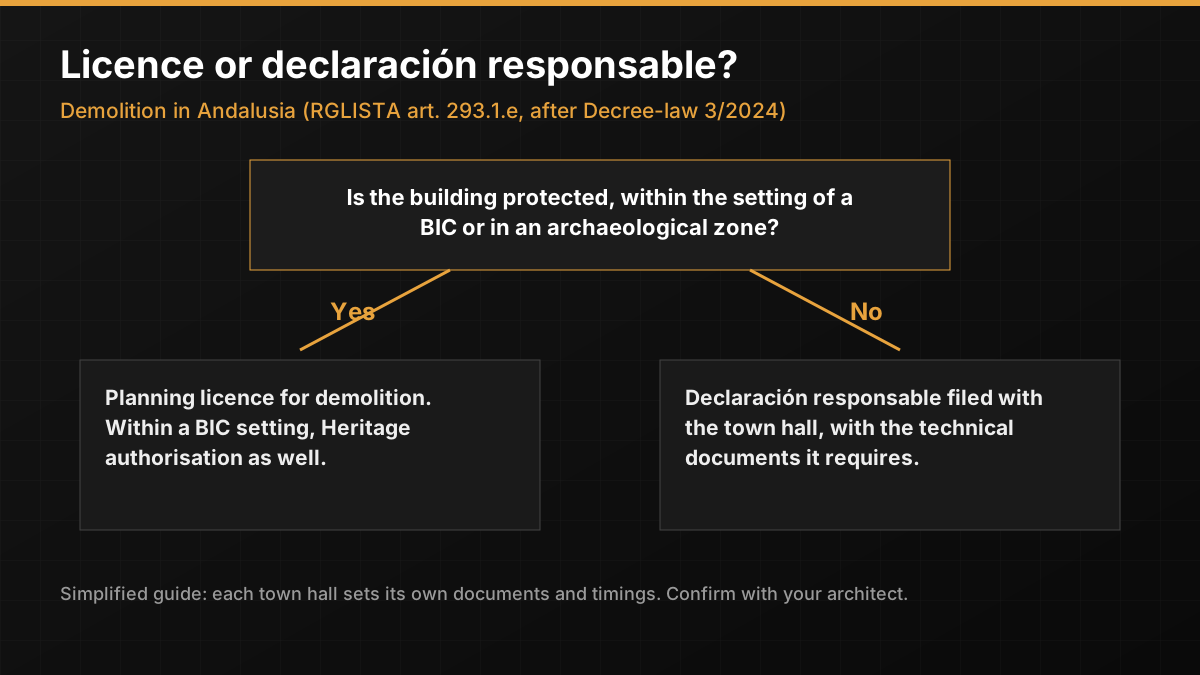
In Andalusia, the total or partial demolition of a building that is not heritage-protected and not inside a protected setting is carried out under a declaración responsable filed with the ayuntamiento (RGLISTA art. 293.1.e, as amended by Decreto-ley 3/2024). Protected buildings, buildings in a protected setting and sites in archaeological zones still need a licencia urbanística. The owner and their técnico handle the filing; the contractor carries out the works.

Contents
- What changed for demolitions in Andalusia in 2024?
- Declaración responsable and licencia: what is the actual difference?
- When do you still need a demolition licence?
- Does a partial demolition follow the same rules?
- Who files the declaración responsable – the contractor or the owner?
- Which other permits and formalities come with a demolition?
- Quick reference: which route is likely for your building?
- A practical checklist before you contact the town hall
- Frequently asked questions
What changed for demolitions in Andalusia in 2024?
The short answer: since Decreto-ley 3/2024, de 6 de febrero, the total or partial demolition of buildings and constructions in Andalusia is processed by declaración responsable instead of a licence, as long as the building is not under heritage protection and does not sit inside a protected setting. The rule is found in article 293.1.e of the Reglamento General of the Andalusian planning law.
The legal framework has two layers. The law itself is Ley 7/2021, de 1 de diciembre, de impulso para la sostenibilidad del territorio de Andalucía, usually shortened to LISTA. Its implementing regulation is Decreto 550/2022, de 29 de noviembre, known as the RGLISTA. The 2024 simplification decree amended that regulation, and the demolition rule you deal with today is the amended version.
Before 2024 the general rule was the licence: the Reglamento required a licencia urbanística for demolitions, with an exception for buildings in imminent physical ruin. Many owners abroad still hear the old rule from neighbours, estate agents or online forums, so it is worth knowing that the default has changed.
Declaración responsable and licencia: what is the actual difference?
A licencia urbanística is a permission the ayuntamiento grants after reviewing your application; you wait for the decision before works begin. A declaración responsable is a formal statement filed by the owner, backed by technical documents, declaring that the planned works comply with the rules. The town hall checks it, but the procedure is built around the owner's responsibility rather than a prior grant.
For an owner living in London, Oslo or Amsterdam, the practical consequences are these:
- Responsibility shifts to you and your técnico. If the declaration is wrong – for example, the building turns out to be in a protected setting – the problem is yours, not the town hall's.
- The paperwork still exists. A declaración responsable is not a one-page form: each ayuntamiento sets in its ordinance which documents must be attached, and for demolitions that normally includes technical documentation signed by a técnico competente.
- Timing depends on the ordinance. When works may begin after filing, and what the town hall can do afterwards, is set locally. Ask your técnico for the rule in your municipality rather than relying on a general answer.
In other words, the declaración responsable is simpler in procedure, not lighter in content. A properly prepared file is what makes it work.
When do you still need a demolition licence?
You still need a licencia urbanística when the building is heritage-protected, when it is included in a protected setting (entorno) or when it lies in an archaeological zone. These are exactly the cases the 2024 change left out of the declaración responsable route.
On the Costa del Sol and inland Málaga this matters more than many buyers expect. Several towns have historic centres declared Bien de Interés Cultural (BIC) as Conjuntos Históricos:
- Málaga city – the Conjunto Histórico was registered as BIC (Decreto 88/2012); any total or partial demolition in the Centro Histórico needs prior authorisation from the regional heritage department (Consejería competente en Patrimonio Histórico).
- Ronda – extension of the Conjunto Histórico by Decreto 199/2001.
- Vélez-Málaga – Conjunto Histórico-Artístico, Decreto 3480/1970.
- Antequera – extended by Decreto 5/2013.
- Archidona – declared in 1980.
- Casares – declared conjunto histórico-artístico in 1978.
In a protected historic centre the demolition needs a licence and, where applicable, heritage authorisation; confirm the exact route with the ayuntamiento before you plan dates. A whitewashed village house that looks ordinary from the street can still fall under this regime because of where it stands.
Does a partial demolition follow the same rules?
Yes. The rule covers total or partial demolition of buildings or constructions, so taking down a wing of a villa, an annex, a first floor or a collapsed outbuilding goes through the same choice: declaración responsable if unprotected, licence if protected or in a protected setting or archaeological zone.
What changes in a partial job is the technical content. When part of a structure stays standing, your técnico has to define how the remaining building is kept stable, where the cut line runs and how the junction is protected afterwards. That is why partial demolitions often need more careful documentation than a full knock-down of a detached house, even though the procedure is the same. Our partial demolition service works from that documentation and executes the separation in the order your técnico specifies.
Who files the declaración responsable – the contractor or the owner?
The owner files it, normally with the help of their técnico. A demolition contractor carries out the works; it does not file the declaración responsable or obtain licences on your behalf. That is how we work at Demoliciones Málaga: we work with the project or technical documentation of your técnico, coordinate dates with your architect and tell you which documents a town hall typically asks for, but the filing stays in your hands.
For the municipal and tax formalities of the works, the owner identifies themselves with their DNI, NIE or NIF. If you live abroad and the property is held by several heirs or by a company, sort out early who signs as promotor; this tends to take longer than the demolition itself.
If you cannot travel, read our page on managing a demolition from abroad: it explains how documents, site access and photo updates are organised when the owner is not in Spain.
Which other permits and formalities come with a demolition?
The planning procedure is the central step, but a demolition usually involves several parallel formalities:
- Public road occupation. If a skip, scaffolding or materials go on the street, you need authorisation to occupy the public road (vía pública). Before starting, the town hall confirms which planning route applies and whether the road occupation permit is needed.
- Waste deposit. Town halls require a fianza o garantía for construction and demolition waste. The amount depends on the municipal ordinance, and it is returned once you prove delivery of the waste to an authorised manager.
- Health and safety documents. Every demolition has an estudio de seguridad y salud or an estudio básico (Real Decreto 1627/1997), from which the contractor prepares its plan.
- Waste documents. The project includes an estudio de gestión de residuos, and the contractor prepares a plan de gestión de residuos (Real Decreto 105/2008).
- Community of owners. If the property is part of a propiedad horizontal (for example a townhouse in an urbanización with shared structure), the community must be informed before walls, structure or façade elements are demolished, and works affecting common elements need the owners' meeting agreement (Ley 49/1960).
Each of these is explained in its own guide; the step-by-step order is covered in demolition step by step: from site visit to cleared plot.
Quick reference: which route is likely for your building?
The table summarises the general rule. It is a starting point for the conversation with your técnico, not a substitute for checking your specific plot.
| Situation | Likely procedure | What to check |
|---|---|---|
| Unprotected detached villa or house in an urbanización | Declaración responsable | Documents required by the local ordinance; road occupation for skips |
| Old finca or cortijo on rustic land, not catalogued | Declaración responsable | Catalogue status; access for machinery; waste deposit |
| Partial demolition of an unprotected building | Declaración responsable | Stability of the remaining structure in the technical documents |
| Building listed in the municipal catalogue | Licencia urbanística | Level of protection; heritage authorisation |
| House inside a Conjunto Histórico (BIC) or protected setting | Licencia, plus heritage authorisation where applicable | Confirm with the ayuntamiento before fixing dates |
| Plot in an archaeological zone | Licencia urbanística | Archaeological conditions set by the authorities |
For Málaga city the new municipal ordinance gives a detailed list; see what the GMU asks for in Málaga city. For coastal towns such as Marbella, Estepona or Mijas, see demolition rules in other Costa del Sol towns.
A practical checklist before you contact the town hall
Owners abroad save weeks by collecting the basics before anyone files anything. A useful pre-check looks like this:
- Get the cadastral reference and a recent nota simple of the property, so ownership and description are clear.
- Ask your técnico to check protection: catalogue status, protected setting, archaeological zone, historic centre.
- Decide the scope: full demolition, partial demolition, or demolition plus later rebuilding. A new build later is a separate procedure.
- Check for asbestos-cement (uralita) roofs, tanks or pipes. If present, the removal is done by a RERA-registered company before the rest of the demolition; on our jobs that company works as our subcontractor. Our sister site explains what the RERA register is.
- Collect photos and measurements: built area, number of floors, access width, neighbours' walls. These are what a contractor needs for a quote; the demolition cost calculator shows which factors move the price.
- Plan utilities: electricity, water and gas supply contracts are cancelled or disconnected before the works start.
With that in hand, the técnico can prepare the documents and you can ask for a no-obligation quote for building demolition or house and villa demolition anywhere in the provincia de Málaga. You can write to us in English.
Sources
Frequently asked questions
Do I need a licence to demolish a house in Andalusia?
Usually not any more. Since Decreto-ley 3/2024, an unprotected house is demolished under a declaración responsable; a licence is only required for protected buildings, protected settings and archaeological zones.
What is a declaración responsable in plain English?
It is a formal statement by the owner, filed with the ayuntamiento with the required technical documents, declaring that the works comply with the rules. The town hall can check it afterwards; responsibility for its accuracy lies with the owner.
Which article of the regulation covers demolitions?
Article 293.1.e of the Reglamento General of the LISTA (Decreto 550/2022), as amended by Decreto-ley 3/2024, lists total or partial demolition among the works done by declaración responsable.
Was a licence always needed before 2024?
Before 2024 the general rule was the licence: the Reglamento required a licencia urbanística for demolitions, except in cases of imminent physical ruin.
Can a demolition company file the declaración responsable for me?
We do not file declarations or obtain licences; the owner and their técnico do. We work with your técnico's documentation and coordinate dates with them.
My villa is in an urbanización – does that change anything?
The procedure is still a declaración responsable if the villa is not protected. Check the community statutes and, if the building shares structure with neighbours under propiedad horizontal, the community's agreement may be needed for works affecting common elements.
Does demolishing only part of a building need a licence?
Not if the building is unprotected: partial demolition follows the same rule as total demolition. It does need careful technical documentation about the part that remains standing.
How do I know if my building is protected?
Your técnico checks the municipal catalogue of protected buildings and whether the plot lies in a protected setting, a Conjunto Histórico or an archaeological zone. The town hall's planning department can confirm it.
Is a NIE required to file the declaración responsable?
For municipal and tax formalities of the works, the owner identifies themselves with their DNI, NIE or NIF. Which identifier you use depends on your situation; your técnico or gestor can advise.
Do I also need permission for the skip on the street?
Yes, if the skip, scaffolding or materials occupy the public road, an authorisation to occupy the vía pública is needed in addition to the planning procedure.
Does the town hall ask for a waste deposit?
Town halls require a fianza or garantía for construction and demolition waste; the amount is set by each municipal ordinance and it is returned once delivery to an authorised manager is proven.
Is demolishing and rebuilding one procedure?
No. The demolition and the new construction are separate works; the new building follows its own planning procedure, which your architect prepares.