In short
Building demolition is the controlled removal of a whole multi-storey structure – a block of flats, an old shop or office building, a hotel annex – usually by machine, top-down, after a selective strip-out. Demoliciones Málaga carries it out across the province of Málaga with the project and studies prepared by your técnico, and sorts the waste on site as Ley 7/2022 requires.
Contents
- What is involved in demolishing a whole building?
- Permits for building demolition: licence, declaración responsable and the project
- Before the machines arrive: surveys, supplies and the community
- How is a multi-storey building demolished? The top-down method
- Reinforced concrete, brick and old masonry: what changes the method?
- Waste, timing and keeping the owner informed
- Frequently asked questions
What is involved in demolishing a whole building?
Demolishing a building means removing its entire structure – roof, floors, walls, frame and, if the project requires it, slabs and foundations – and leaving the plot ready for what comes next. On a multi-storey building the work is never a single operation; it is a planned sequence in which each stage keeps the rest of the structure stable.
The buildings we demolish in the province of Málaga include:
- older apartment blocks with load-bearing brick walls or a reinforced concrete frame;
- mixed-use buildings with a shop or garage on the ground floor and flats above;
- obsolete commercial and office buildings, small hotels and annexes;
- old industrial or agricultural buildings within a town – for larger sheds, see our sister site for warehouse and industrial demolition.
For a detached house or villa the logic is the same but simpler; that case has its own page on house and villa demolition.
Permits for building demolition: licence, declaración responsable and the project
To demolish the existing building you need the municipal permit and the technical documentation that supports it. In Andalusia, since Decreto-ley 3/2024, a total demolition is generally carried out by declaración responsable, while buildings with heritage protection, in a protected setting or in an archaeological zone still need a licencia urbanística.
Owners and developers often ask whether this is a "major or minor building licence", or how to get licences for demolition and rebuilding at the same time. Those questions belong to your architect, who knows how your ayuntamiento handles them. What is fixed is that the demolition documentation – a project or technical report, a health and safety study and a waste management study – is drafted and signed by a técnico competente, and that the owner files it. In Málaga city, the OMLU ordinance asks for a project or technical report with a technical certificate, a separate document if the works occupy the public road, and photographs.
Our guides go into the detail: demolition permits in Andalusia and who signs a demolition project in Spain and when you need one.
Before the machines arrive: surveys, supplies and the community
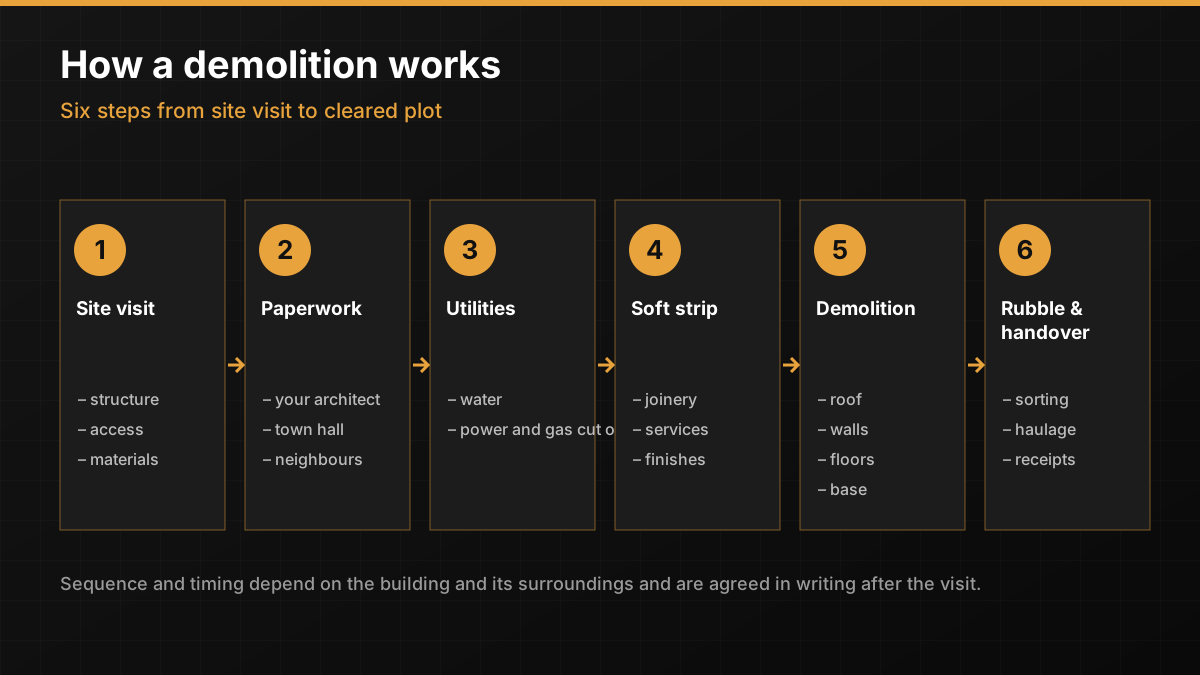
Most of the risk in a building demolition is removed before the first wall comes down. The preparation we go through with your técnico covers:
- Hazardous materials. Asbestos-cement in roofs, downpipes, water tanks or ducts is identified and removed first by a RERA-registered company working as our subcontractor, under its own work plan approved by the labour authority.
- Supplies. Electricity, gas, water and telecoms are disconnected by the supply companies at the owner's request; drains are sealed as the técnico specifies.
- Neighbouring buildings. Party walls, shared foundations and adjoining roofs are recorded with photos and the técnico decides which need protection or propping.
- Public road. Containers, fencing, platforms or a machine on the street require municipal authorisation to occupy the public road.
- Community of owners. In a building under propiedad horizontal, the community must be informed before walls, structure or façade elements are demolished, and works affecting common elements need the owners' meeting agreement (Ley 49/1960).
The contractor also prepares its health and safety plan from the técnico's study, as Real Decreto 1627/1997 requires, and its plan for managing the waste. Our guide on health and safety on a Spanish demolition site explains how the study, the plan and the coordinator fit together.
How is a multi-storey building demolished? The top-down method
Multi-storey buildings are demolished from the top down, floor by floor, so that the structure below always carries what is left above. The machine chosen depends on height and access.

- Selective strip-out. Windows, doors, timber, metal fittings, plaster partitions and installations come out first, by hand, so that the structural demolition produces clean mineral rubble.
- Roof and top floor. A long-reach excavator with shears or a crusher bites into the top of the structure; on lower buildings a standard excavator with a grapple is enough.
- Floor by floor. Slabs, beams and columns are brought down in order, with the debris kept inside the building footprint and away from the street.
- Ground floor and basement. The lowest levels are demolished last; basement walls that retain a street or a neighbour's ground are only removed where the project provides for it.
- Slabs and foundations. Broken out with a hydraulic breaker if the project includes them.
Throughout the work, water is sprayed at the point of demolition to keep dust down. The differences between machine and hand techniques are set out in our comparison of excavators, shears and breakers.
Reinforced concrete, brick and old masonry: what changes the method?
The material of the structure decides the tools, the pace and the waste streams. Three situations cover most buildings in the province:
| Structure | Typical method | Main waste |
|---|---|---|
| Reinforced concrete frame | Crusher or shears to break concrete and cut reinforcement; breaker for heavy elements | Concrete, iron and steel |
| Load-bearing brick walls with concrete or steel-joist floors | Grapple and shears, floor by floor | Bricks, mixtures of concrete, bricks and ceramics, metal |
| Old stone or rammed-earth walls with timber roofs | Careful mechanical demolition; hand work near neighbours | Soil and stones, wood, tiles and ceramics |
Concrete rubble can, where the project allows, be crushed on site and reused as fill; our sister site explains when on-site crushing and recycling makes sense.
Waste, timing and keeping the owner informed
A building demolition produces a large volume of waste, and since January 2024 the demolition has to be selective so that it can be sorted. We separate concrete and masonry, wood, metals, glass, plastic and plaster as the building comes down, take each fraction to an authorised facility and hand you the delivery receipts. The detail of those rules is in our guide on selective demolition under Law 7/2022.
How long the work takes depends on the size of the building, the structure, access and how much has to be done by hand; you get a realistic programme with the quote, not a promise. If the owner or developer is abroad, we send photos at each stage and coordinate directly with the architect and the health and safety coordinator. For the complete chain from demolition to a clear plot, see demolition and debris removal.
Frequently asked questions
Can you demolish a block of flats?
Yes. Multi-storey residential, commercial and mixed-use buildings are demolished top-down by machine after a selective strip-out, using the project prepared by your técnico.
Do I need a licence to demolish a building in Andalusia?
Generally a declaración responsable is enough since Decreto-ley 3/2024. Buildings with heritage protection, in a protected setting or in an archaeological zone still need a licence.
Is a demolition project always required?
The demolition is documented by a project or a technical report signed by a técnico competente; which one depends on the building and on what the town hall asks for.
Can the demolition and new build be applied for together?
That depends on how your ayuntamiento handles the paperwork, and it is a question for your architect. We follow whatever documentation they prepare.
What happens to the building next door?
Party walls and adjoining structures are recorded before the start, and your técnico decides what protection or propping they need. The demolition next to them is done in a controlled way, partly by hand.
How do you keep dust down?
Water is sprayed at the point of demolition and on the rubble as it is loaded, and the work is sequenced to keep debris inside the building footprint.
What if the building has asbestos?
Asbestos-containing materials are removed first by a RERA-registered company working as our subcontractor, under its approved work plan. The demolition starts once that is done.
Do I need the community's agreement?
In a building under propiedad horizontal, the community must be informed before structural or façade elements are demolished, and works on common elements need the owners' meeting agreement.
Do you remove the foundations too?
If the project includes them, yes: slabs and foundations are broken out with a hydraulic breaker and taken away with the rest of the waste.
Who appoints the health and safety coordinator?
The promotor appoints the coordinator during execution when several companies or self-employed workers take part, as Real Decreto 1627/1997 provides.