In short
Across Andalusia, unprotected buildings are demolished under a declaración responsable and protected ones need a licence, but each ayuntamiento on the Costa del Sol sets documents and deadlines in its own ordinance. Mijas uses an official declaración responsable for works citing RGLISTA art. 293.1, Benalmádena does not allow skips or materials on the public road without a permit, and Marbella has a declaración responsable procedure for works whose scope for demolitions is still to be verified. Historic centres such as Casares, Ronda or Vélez-Málaga fall under the licence and heritage regime.

Contents
- What is the same in every Costa del Sol town?
- Mijas
- Benalmádena
- Marbella
- Estepona, Fuengirola, Torremolinos and the rest of the coast
- Historic centres: Casares, Ronda, Vélez-Málaga, Antequera, Archidona
- Inland towns: the Guadalhorce valley, the Axarquía and the Serranía
- Urbanizaciones and communities: rules beyond the town hall
- A checklist that works in any town
- How we work across the provincia de Málaga
- Frequently asked questions
What is the same in every Costa del Sol town?
The planning framework is regional, so the basic rule is identical from Manilva to Nerja: since Decreto-ley 3/2024, the total or partial demolition of a building that is not heritage-protected and not in a protected setting goes through a declaración responsable (RGLISTA art. 293.1.e). Protected buildings, protected settings and archaeological zones need a licencia urbanística.
Other elements are also common to all towns, because they come from national or regional law:
- signed technical documentation by a técnico competente;
- a safety study or basic study under Real Decreto 1627/1997;
- a waste study in the project and a waste management plan by the contractor;
- selective demolition and sorting of waste under Ley 7/2022;
- a waste deposit (fianza o garantía) set by the municipal ordinance and returned on proof of delivery to an authorised manager;
- asbestos removed by a RERA-registered company under an approved plan de trabajo.
What differs is the local layer: forms, the exact list of attachments, how the file is submitted, fees and deadlines.
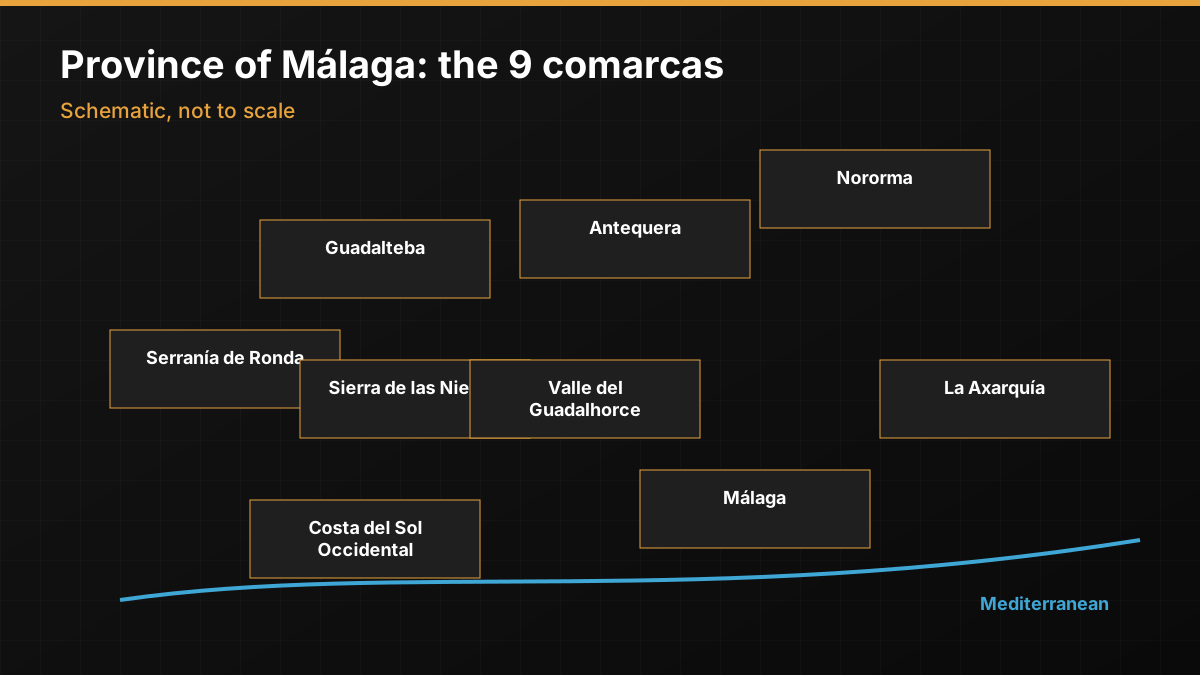
Mijas
Mijas has an official declaración responsable form for works that cites article 293.1 of the RGLISTA. Works that affect the public road need prior authorisation. Mijas also requires a waste deposit for construction and demolition waste, returned once delivery to an authorised manager is proven, and its ordinances regulate the owner's duty to keep plots clean, with the town hall able to act at the owner's expense if they do not.
Mijas combines a historic hilltop village, large urbanizaciones and the coastal areas of La Cala de Mijas, Las Lagunas and Mijas Costa, so demolitions range from old village houses to detached villas with pools. Our Mijas page describes the typical jobs there.
Benalmádena
In Benalmádena, the public road may not be occupied by skips or materials without a permit, as set in its fiscal ordinance OF-18. For a demolition this means the road occupation has to be authorised before the first skip arrives, which is particularly relevant in Arroyo de la Miel and the older streets of Benalmádena Pueblo.
The planning procedure itself follows the regional rule; the exact documents for a demolition declaración in Benalmádena are set by the town hall – check them with your técnico. See our Benalmádena page.
Marbella
Marbella has a declaración responsable procedure for the execution of works. Whether demolitions are included in that procedure, and with which attachments, is (to be verified) with the ayuntamiento or your técnico before you plan dates.
Marbella's building stock is very mixed: villas from several decades in urbanizaciones in and around Nueva Andalucía and San Pedro Alcántara, townhouses in the old town around the former walled precinct, and rural properties in the hills. The old town and any catalogued buildings need particular care with protection status. Our Marbella page covers the work we do there; our office is in Marbella.
Estepona, Fuengirola, Torremolinos and the rest of the coast
For Estepona, Fuengirola, Torremolinos, Manilva, Rincón de la Victoria, Torrox, Nerja and the other coastal towns, the specific municipal procedure for demolitions is (to be verified). Each ayuntamiento sets the documents and deadlines in its ordinance; consult your técnico or the town hall.
Two points have been confirmed beyond Mijas: Vélez-Málaga and Rincón de la Victoria require a waste deposit for construction and demolition waste, returned on proof of delivery. In every town, if a skip or scaffolding goes on the street, an authorisation to occupy the public road is needed. Ask for it at the same time as the planning procedure, because a demolition cannot load a single lorry without it in a street with no space inside the plot.
Local pages with the typical demolition situations: Estepona, Fuengirola, Torremolinos, Manilva, Nerja and Rincón de la Victoria.
Historic centres: Casares, Ronda, Vélez-Málaga, Antequera, Archidona
Several towns in the provincia de Málaga have historic centres declared Conjuntos Históricos (BIC):
- Casares – declared conjunto histórico-artístico in 1978;
- Ronda – extension of the Conjunto Histórico by Decreto 199/2001;
- Vélez-Málaga – Conjunto Histórico-Artístico by Decreto 3480/1970;
- Antequera – extended by Decreto 5/2013;
- Archidona – declared in 1980.
In a protected historic centre, a demolition needs a licence and, where applicable, authorisation from the heritage authorities; confirm it with the ayuntamiento. Outside the protected perimeter, the same towns follow the general declaración responsable rule for unprotected buildings. See Casares, Ronda and Vélez-Málaga.
Inland towns: the Guadalhorce valley, the Axarquía and the Serranía
Many foreign owners have bought away from the beach: around Alhaurín de la Torre, Alhaurín el Grande, Coín, Cártama and Álora in the Valle del Guadalhorce, in the villages of the Axarquía behind Vélez-Málaga and Torrox, or in the Serranía de Ronda. For these municipalities the specific demolition procedure is also (to be verified) town by town; the regional rule – declaración responsable for unprotected buildings, licence for protected ones – applies everywhere.
What changes inland is less the procedure than the property. Typical situations include:
- Fincas on rustic land with a main house, later extensions and farm buildings, often with uralita roofs on sheds and stores;
- Access by narrow tracks, which limits lorry size and favours smaller machines and more loads;
- Village houses in compact historic cores, where hand demolition and small loads are the norm;
- Plots near forest land, where the fire-prevention duties of the Zona de Influencia Forestal – land within 400 metres of forest areas under Ley 5/1999 – apply after the demolition too.
See our pages for Alhaurín de la Torre, Coín, La Axarquía and the Serranía de Ronda, and our finca demolition service.
Urbanizaciones and communities: rules beyond the town hall
On the Costa del Sol a large share of villas and townhouses sit in urbanizaciones with a community of owners. The town hall decides on the planning procedure, but the community can matter just as much in practice.
- Propiedad horizontal. Under Ley 49/1960, before walls, structure or façade elements are demolished in a building under propiedad horizontal, the community must be informed, and works affecting common elements need the owners' meeting agreement. Terraced and semi-detached houses sharing structure are the typical case.
- Community rules on works. Many urbanizaciones set their own rules on working hours, access of heavy vehicles through community roads or gates, and cleaning of shared areas. Ask the administrator for them before you fix dates.
- Access and gates. Gate widths, barriers and private roads can decide which machines and lorries can reach the plot.
Telling the administrator early, with the dates and the contractor's contact details, avoids blocked gates on the first morning.
A checklist that works in any town
Because the local details vary and some are still to be confirmed, the safest approach is a checklist that works anywhere on the coast or inland:
- Protection status: catalogue, protected setting, archaeological zone, historic centre.
- Procedure: declaración responsable or licence, and the town's form and list of attachments.
- Technical documents: proyecto or memoria técnica, safety study, waste study, signed by your técnico.
- Waste deposit: amount and how it is paid and returned under the local ordinance.
- Road occupation: skips, lorries, scaffolding, crane.
- Asbestos: survey, RERA-registered company, plan de trabajo.
- Community of owners, if the property is in a propiedad horizontal: information before structural or façade works, and the owners' meeting agreement for works on common elements.
- Identification: for municipal and tax formalities the owner identifies themselves with their DNI, NIE or NIF.
Pools, terraces and garden structures often raise their own permit questions; our sister site covers whether you need a permit to remove a pool.
How we work across the provincia de Málaga
We carry out demolitions in every municipality of the provincia de Málaga, on the coast and inland. Wherever the property is, the division of roles is the same: you and your técnico handle the declaración or licence; we work from the técnico's documentation, coordinate dates, tell you which documents the town hall usually asks for, carry out the demolition and hand you the waste receipts.
For detached houses and villas, see house and villa demolition; for apartment blocks, commercial or larger buildings, building demolition. If you are coordinating everything from abroad, our remote management page explains how we report in English. For Málaga city itself, read what the GMU asks for.
Sources
Frequently asked questions
Is the demolition procedure the same in every Costa del Sol town?
The regional rule is the same: declaración responsable for unprotected buildings, licence for protected ones. Each ayuntamiento sets documents, forms and deadlines in its own ordinance.
Does Marbella accept a declaración responsable for demolitions?
Marbella has a declaración responsable procedure for works; whether demolitions are included is to be verified with the town hall or your técnico.
What does Mijas require?
Mijas uses an official declaración responsable for works citing RGLISTA art. 293.1, and works affecting the public road need prior authorisation.
Can I put a skip on the street in Benalmádena?
Only with a permit: Benalmádena's fiscal ordinance OF-18 does not allow the public road to be occupied by skips or materials without one.
What are the rules in Estepona or Fuengirola?
Their specific demolition procedures are to be verified; each ayuntamiento sets documents and deadlines in its ordinance, so check with your técnico or the town hall.
Do all towns ask for a waste deposit?
Town halls require a fianza or garantía for construction and demolition waste; it has been confirmed in Mijas, Vélez-Málaga and Rincón de la Victoria. The amount depends on each ordinance.
Is Casares old town protected?
Casares was declared a conjunto histórico-artístico in 1978. In a protected historic centre a demolition needs a licence and, where applicable, heritage authorisation.
Does a house in Ronda need a licence to be demolished?
If it is inside the protected Conjunto Histórico or is catalogued, yes, plus heritage authorisation where applicable. Outside it, the general rule for unprotected buildings applies.
Do I need a NIE to demolish in Marbella?
For municipal and tax formalities the owner identifies themselves with their DNI, NIE or NIF; your gestor or técnico can tell you which applies to you.
Do you work in inland towns too?
Yes, we carry out demolitions throughout the provincia de Málaga, coastal and inland.
Will you check the local rules for me?
We tell you which documents a town hall usually asks for, but the procedure itself is confirmed and filed by you and your técnico.